

Zone 36 Padel
Padel at Zone 36
Padel in Islamabad,
explained properly.
It is the fastest-growing racket sport in the world and it has landed in Pakistan hard. If you have never held a padel racket, this page is for you — you will know enough to play by the end of it.
The short version
Tennis, squash and a bit of common sense.
Padel is played in doubles on a court roughly a third the size of a tennis court, enclosed by glass and mesh. The racket is solid and stringless. The serve is underarm. And — this is the part people love — the walls are in play, so the ball keeps coming back and rallies last far longer than they would in tennis.
That combination is why padel spreads so fast. A complete beginner and a decent player can have a genuinely competitive game together, which is almost impossible in tennis or squash.
Always four players
Two a side. Singles padel exists but the court at Zone 36, like almost every court, is built for doubles.
Solid racket, no strings
Perforated, stringless and short-handled. Much easier to control than a tennis racket on day one.
Walls are part of the game
After the ball bounces on your side, it can come off the glass and you can still play it. This is the skill that takes longest to learn — and it is the fun part.
An hour is a real game
Most groups book one hour and play plenty. Two hours if you want a proper session or you are rotating five or six people.
How to play
Six rules and you are playing.
Serve underarm, below the waist
Bounce the ball once on the ground, then hit it below waist height, diagonally into the opposite service box. Two serves, like tennis.
Scoring is tennis scoring
15, 30, 40, game. Six games take a set. Nothing new to learn here.
The ball must bounce before it hits a wall
On your side, the ball has to bounce on the floor first. If it strikes the glass before bouncing, you have lost the point.
After the bounce, the walls are yours
Let it come off the glass and play it back. Using the back wall to your advantage is the single biggest thing that separates a beginner from a good player.
You may volley — except the serve return
The return of serve has to bounce first. Everything after that can be taken out of the air.
Out is out
If the ball goes over the enclosure or hits the mesh on the full on your opponent's side before bouncing, the point is over.
That is genuinely enough to start. The finer points — the lob, coming to the net, playing the ball off the back glass — come from playing, not from reading.
The court
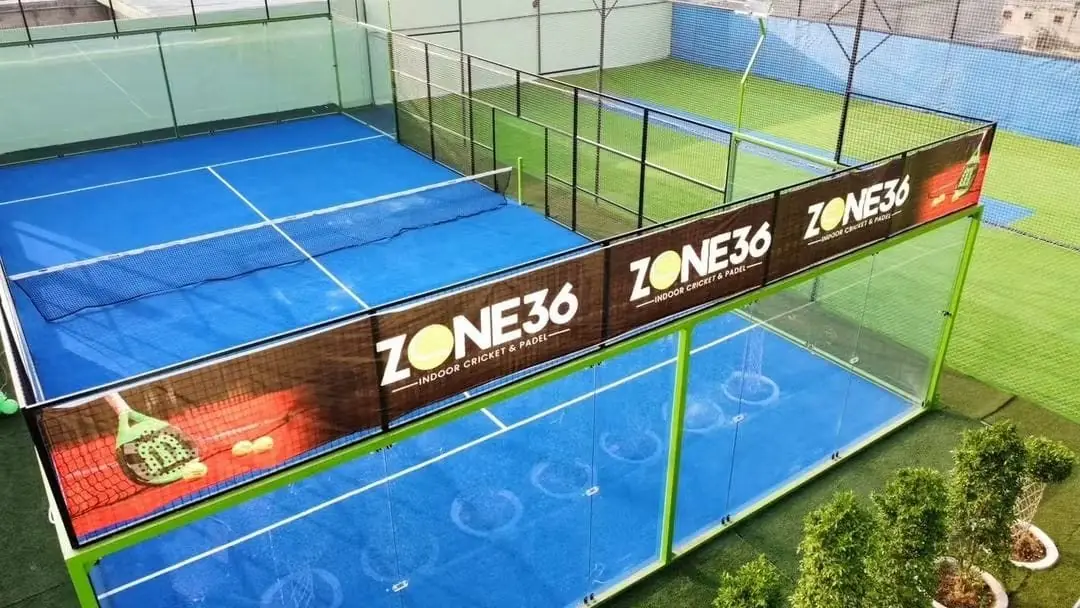
Glass walls, floodlit, open till 8 AM.
Zone 36 has one padel court in Jeddah Town, off Main GT Road. Blue playing surface, glass back and side panels, mesh above, and full floodlighting — so a 1 AM game plays exactly like a 6 PM one.
Padel rates
What an hour costs.
Padel court
| 1 hour | Rs 3,500Rs 3,000 |
|---|---|
| 2 hours | Rs 5,000 |
| 1 hour | Rs 4,000Rs 3,500 |
|---|---|
| 2 hours | Rs 6,000 |
That is for the whole court, not per player — four of you splitting a floodlit hour is Rs 875 each. Payment at the venue.
First time
Turning up with no idea what you are doing
Do I need to have played tennis?
What should I wear?
Do I need my own racket?
We are only three people. Can we still play?
Can we book the padel court and the cricket arena together?
Four of you. One hour. Rs 875 each.
Book the court, turn up, and someone will show you where to stand.
Book the court